It’s 9:47 AM on a Tuesday. You’re mid-way through a vendor renewal, someone just DMed you asking how many PTO days they have left, there’s a receipt photo sitting in your WhatsApp from a sales rep who traveled last week, and a new hire just asked where to submit their laptop request. None of this is your job title. All of it is your morning.
If you’re the operations manager, chief of staff, or just the person who keeps the wheels on at a fast-growing startup, this is not an unusual Tuesday. This is Tuesday.
Operations managers at 30- to 80-person companies often find themselves handling HR, IT, and finance responsibilities without dedicated teams. The most common challenges include managing employee leave, tracking expenses, handling workplace requests, and answering repetitive employee questions. Slack-native tools such as AttendanceBot for leave management, Expensetron for expense tracking, and OfficeAmp for internal helpdesk help growing companies automate these workflows inside Slack or Microsoft Teams. By replacing spreadsheets, scattered messages, and manual processes with integrated systems, organizations can scale operations efficiently without adding headcount.
The trap no one warns you about
There’s a specific kind of organizational pain that kicks in somewhere around 30 to 50 employees. Below that, informal systems work fine — someone asks you directly, you answer, done. Above 80 or so, you can actually justify dedicated HR, IT, and finance hires.
But in the middle? You’re in no-man’s land.
Your team is too big for “just Slack me” to scale, but too small for anyone to greenlight a full HR platform with a six-month implementation and a price tag that needs board approval. So you improvise. You build spreadsheets. You make a shared Google Doc that nobody updates. You become the single point of failure for four different operational functions — and the whole thing works right up until it really doesn’t.
This is the trap. It’s not a management failure. It’s a structural one. And there’s a specific, lightweight way out of it.
The four areas that break first
Leave and PTO: the chaos nobody talks about
Someone books a week off. They tell their manager. Maybe they also tell you. Maybe they remember to mark it on the shared calendar. Maybe. Now multiply that by 50 people, add a few different leave policies for different contract types, throw in a few overlapping requests from the same team, and try to answer the simple question: who’s actually in the office next week?
The honest answer, for most companies at this stage, is: nobody knows for sure.
Leave management without HR usually means a patchwork of calendar entries, Slack messages, and a spreadsheet that’s three weeks out of date. The paper trail, when someone asks for it, doesn’t really exist. AttendanceBot solves this without asking your team to log into yet another tool — leave requests, approvals, balances, and calendar syncing all happen inside Slack or Teams, where your people already live. It takes about an afternoon to set up, and from that point the spreadsheet can retire.


Expense reporting: receipts in the wrong chat
At some point, a well-meaning sales rep sends you a photo of a crumpled restaurant receipt via WhatsApp and considers the matter closed. He is not wrong to think this, because that’s how it’s worked up to now.
Expense tracking for small teams almost always collapses into some combination of receipts over messaging apps, a shared spreadsheet that finance updates monthly when they remember, and a quarterly scramble to figure out what was actually spent on what. It’s not that people are disorganized — it’s that there’s no system with enough friction to actually capture everything in real time.
ExpenseTron brings expense submission into Slack, so your team can log expenses the moment they happen — which is the only moment they’ll actually do it. Approvals happen in-channel. The data’s there when you need it, without chasing anyone down.


IT and facilities requests: DMs that disappear forever
When there’s no formal IT process, IT requests become a game of “find the right person and hope they don’t forget.” Someone DMs the guy who set up their laptop. That DM sits unread for two days. A new hire doesn’t know who to even ask. Someone’s standing desk request gets mentioned in a team call and everyone nods, then nothing happens.
The deeper problem isn’t the individual request — it’s that there’s no queue, no ownership, and no way to know what’s been done versus what’s just been talked about. Things fall through cracks, and the person who chased the loudest usually wins.
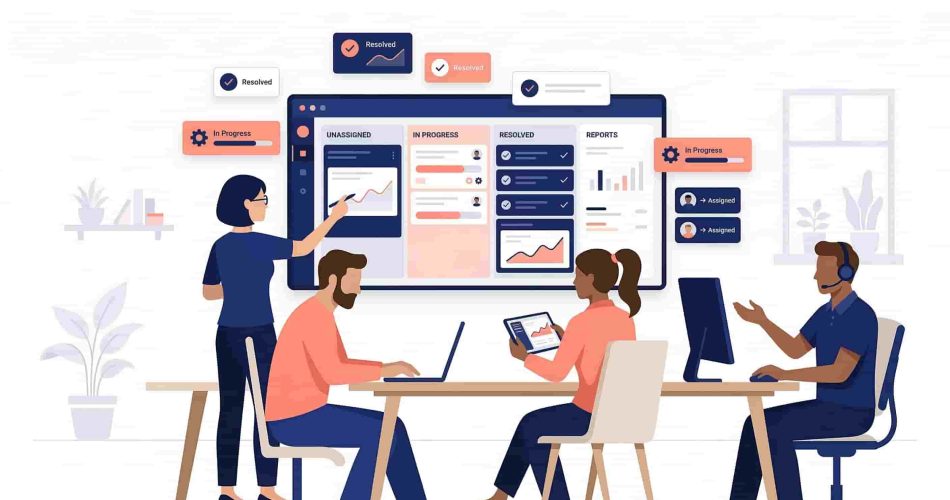
A Slack helpdesk for startups like OfficeAmp turns ad-hoc DMs into tracked tickets — right inside Slack. Requests get assigned, acknowledged, and resolved without anyone needing to change their behavior dramatically. You go from “I think I mentioned it to someone” to “the ticket’s closed and here’s what was done.”
Internal FAQs: answering the same question for the tenth time
“What’s our expense limit for client dinners?” “How do I request a day off?” “Where’s the onboarding doc?” “What’s the WiFi password at the new office?” Every company has a version of these questions, and at the 50-person stage, someone — usually you — is answering them manually, repeatedly, forever.
The real cost isn’t the two minutes it takes to answer. It’s the interruption, multiplied across a week, across a team that’s growing. OfficeAmp includes a knowledge base feature that lets you publish answers once, surface them inside Slack, and let the bot handle the repeat questions automatically. New hires get what they need. You get your mornings back.


What “good” actually looks like at this stage
Good, at 50 people, doesn’t look like a full HR department. It looks like processes that run without you holding them together.
Leave requests come in through Slack, get approved by the right manager, and update a calendar automatically. Expense submissions happen in the moment, not at month-end. IT requests have an owner and a status, and the person who submitted them doesn’t have to follow up three times. Common questions get answered by the system, not by you.
The Slack-native ops stack working together means your team never has to leave the tool they’re already in all day. There’s no new login to forget, no separate portal to train people on. The ops layer is just… there, built into the communication layer your company already runs on.
You’re not invisible in this picture — you’re just not the bottleneck. That’s the goal.
Where to actually start
If you’re trying to figure out where to put your energy first, the honest ops manager’s guide for a small company answer is: start with leave management.
It’s the most visible problem. People feel it directly, their managers feel it, and the lack of a paper trail creates real risk when someone disputes something later. It’s also the fastest to fix — AttendanceBot can be running in your Slack workspace in a few hours, and you’ll feel the difference in the first week.
Once that’s stable, expense tracking is usually the next lever. It’s not the loudest problem, but it compounds quietly — and cleaning up a quarter of messy expense data takes far longer than the time you’d spend setting up a proper system upfront.
IT and knowledge management can follow. They matter, but they’re slower burns. Fix the things that create daily friction first, then work outward.
The right order depends on your team, but this sequencing works for most companies in this range: leave, then expenses, then helpdesk and knowledge base. Don’t try to do all of it at once — pick the thing that’s causing the most pain right now and start there.
Being the de facto HR, IT, and finance team at a fast-growing startup sounds like a bug. It’s actually a feature — if you set it up right. Small teams move faster, make decisions quicker, and can implement tools in days rather than months. You’re not handicapped by the absence of dedicated departments. You’re unencumbered by bureaucracy.
The tools exist to help you run this well without adding headcount. AttendanceBot, Expensetron, and OfficeAmp are all built for exactly this moment — Slack-native, fast to deploy, and priced for teams that aren’t enterprise yet. Worth a look if any of this felt a little too familiar.
FAQs
What is the best way to manage employee leave without an HR team?
Growing companies often struggle to track leave requests through spreadsheets, calendars, and chat messages. A leave management solution such as AttendanceBot centralizes PTO requests, approvals, leave balances, and team calendars inside Slack and Microsoft Teams, making leave administration easier for managers and employees.
What is the biggest operational challenge for a 50-person company?
The biggest challenge is scaling processes before dedicated departments exist. Operations managers often become responsible for leave administration, expense approvals, IT requests, onboarding coordination, and employee support, creating bottlenecks as the company grows.
How can small companies improve expense management?
The most effective approach is to capture expenses as soon as they occur. Expensetron allows employees to submit expenses directly from Slack, reducing lost receipts, speeding up approvals, and improving financial visibility without adding administrative overhead.
What is a Slack helpdesk, and why do startups need one?
A Slack helpdesk transforms employee requests into structured tickets that can be assigned, tracked, and resolved. OfficeAmp helps growing companies manage IT, facilities, HR, and workplace requests directly inside Slack, ensuring requests don’t get lost in direct messages.
How can companies reduce repetitive employee questions?
Creating a searchable internal knowledge base is one of the most effective solutions. OfficeAmp enables organizations to publish answers to common questions and surface information directly inside Slack, helping operations teams spend less time answering the same questions repeatedly.
Which processes should operations managers automate first?
For most companies, leave management should be the first priority because it affects every employee and manager. AttendanceBot is often the fastest operational win, followed by expense management with Expensetron and request management and knowledge sharing through OfficeAmp.